
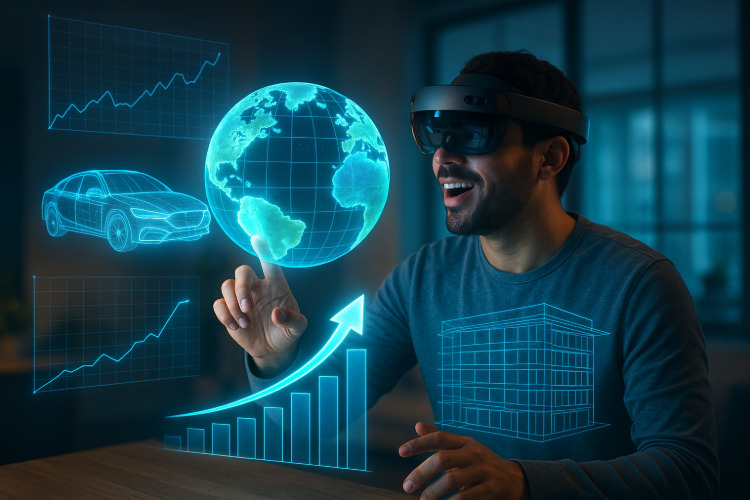
Mixed reality (MR) blurs the lines between the real and virtual worlds, it transforms how we perceive and interact with our surroundings. Although many industries haven’t adopted mixed reality (MR) widely yet, businesses can use mixed reality (MR) to fundamentally reshape processes. Mixed reality (MR) has already started accelerating, promising a completely new hybrid environment.
But how does MR work?
And what future does it hold?
Table of Contents:
- – Mixed Reality: What Is It?
- – Real-world Examples of Mixed Reality
- – Gaming Applications of Mixed Reality: Leading Cases
- – Education and Technology Come Together in Mixed Reality Learning
- – What Are Some Real-World Instances of Augmented, Virtual, and Mixed reality?
- – Mixed Reality in Retail and Business
- – How Retailers Use Mixed Reality
- – The Expanding Role of Mixed Reality
- – Conclusion
Mixed Reality: What Is It?
Digital and real-world elements can coexist and interact with one another in mixed reality (MR), a blend of virtual and physical worlds. Although it goes beyond these three ideas, it includes elements of virtual reality (VR), augmented reality (AR), and the Internet of Things (IoT). Here is a brief summary.
Using the camera on your smartphone, tablet, or even a digital mirror in a mall, augmented reality (AR) can enable you see or show a virtual object in the real environment. Uses of mixed reality (MR) include virtual cosmetics, Snapchat effects, and furniture fitting.
VR, on the other hand, immerses you in a fully virtual world but necessitates specialised gear, such as controllers and a VR headset. Sports training and flight simulation, not to mention gaming, make extensive use of virtual reality.
Mixed reality (MR) applications, which are based on these two realities, let you work with and alter aspects of the actual and virtual worlds. For instance, you can open a virtual package that is placed on your actual bedside table to examine what’s inside. Mixed reality (MR) is a form of immersive AR that isn’t restricted to a single screen or audience. Rather, it makes use of specialised gear, such as a headset or glasses with controls, similar to virtual reality.
To put it briefly, mixed reality (MR) combines augmented reality with the less well-known idea of enhanced virtuality, which is similar to video games in which real-life elements, including players, are combined into a virtual setting.
There is a good likelihood that mixed reality (MR) technology will be widely used in many industries as it develops and becomes more affordable. If you’re curious about what that means, let’s examine how MR is already transforming our interactions with the outside world and bringing enchantment into everyday life.
Real-world Examples of Mixed Reality
Mixed reality (MR) is already reshaping daily life and work. Once limited to trade show demos, mixed reality (MR) now delivers real, practical value.
Here are some common mixed reality (MR) examples and the benefits businesses and individuals can gain from them.
Gaming Applications of Mixed Reality: Leading Cases
By incorporating the real world into an immersive gaming experience, mixed reality (MR) has ushered in a new era of gaming. In essence, it gives us the ability to extend our real environment by enabling real-time manipulation of both digital and physical items.
There are numerous instances of mixed reality (MR) in gaming, and the technology offers numerous advantages for this industry. Adding a social component to virtual gaming is one of them. Up until now, virtual games often only allowed the wearer of the headset to perceive digital things, therefore the gaming experience they offered was completely lonely. By establishing a shared virtual environment, mixed reality (MR) holds the potential to address this issue. In other words, numerous headsets allow several players to share the gaming experience.
For example, Magic Leap has already released well-known mixed reality games. It is worthwhile to explore well-known titles like Star Wars, Game of Thrones, and Angry Birds, which are supported by NVIDIA’s Parker SoC (the Jetson Tegra TX2) CPU and 120Hz refresh rate.
Although Microsoft’s HoloLens 2 is more geared towards companies and the educational sector than Magic Leap, it nevertheless offers a number of intriguing mixed reality (MR) applications, like Fragments, RoboRaid, and ZARZL.
Education and Technology Come Together in Mixed Reality Learning
Educators are using mixed reality (MR) to make learning more engaging and easier to grasp. Though still new in classrooms, mixed reality (MR) already shows promising results. One Microsoft study reported that mixed reality (MR) increased college student engagement and retention by 35% and improved test scores by 22%.
Schools and businesses alike use mixed reality (MR) to provide hands-on learning experiences. For example, trainers can expose employees to complex or hazardous machinery through simulations, reducing risks while still teaching essential skills.
What Are Some Real-World Instances of Augmented, Virtual, and Mixed reality?
Submarine personnel can receive virtual reality training from Immerse, a business that creates XR platforms and solutions for professional training. It enables future team members to practice together at any time and from any location by immersing themselves in a virtual undersea environment.
MR holograms can be used by physicians and medical students to practise a variety of intricate operations. For instance, Fundamental VR’s spinal surgery simulation allows mixed reality (MR) to replicate the sensation of doing spinal column surgery.
Another illustration of the use of immersive technologies in medical education is Microsoft’s HoloAnatomy. The first augmented reality healthcare education mixed reality (MR) app that offered students an interactive anatomy curriculum was created in 2016. Based on mixed reality (MR) technology, HoloAnatomy uses immersive and digital technologies to help with in-depth human anatomy research.
There are numerous benefits of using mixed reality (MR) in education over conventional teaching techniques, such as:
• Considerable financial savings. Holograms can successfully replace pricey and breakable instructional aids.
• Higher productivity among students. Performance on skills-based tasks is enhanced and information bottlenecks are lessened with mixed reality (MR).
• Quicker learning. Learners can absorb difficult knowledge more quickly in immersive situations.
• Enhanced security. In hazardous jobs and sectors like oil and gas, safety is essential. Workers can receive on-the-job training using mixed reality (MR) with little interruption to their work operations, such as at an oil refinery.
The cost of implementation and hardware is undoubtedly preventing mixed reality (MR) technologies from being widely used in colleges and institutions. Nevertheless, as the market for mixed reality (MR) expands, prices will unavoidably decrease, and the technology is positioned to democratise and transform education.
Mixed Reality in Retail and Business
Examples of mixed reality (MR) in retail and business settings show that mixed reality (MR) technologies have all the necessary components to be an effective instrument for enhancing business procedures. International businesses are already making significant investments in mixed reality (MR) to create completely new immersive experiences in place of flat screens and keyboards. Mixed reality (MR) provides the following promises to the corporate world:
• Improved dialogue. Using mixed reality (MR) gadgets to conduct a lifelike meeting eliminates the need for commuting and business travel.
• Higher output. In order to facilitate real-time collaboration and troubleshooting, mixed reality (MR) glasses can help teams and workforces interact by displaying what coworkers see through a live video stream.
• More easily accessible instruction. Without endangering any firm assets, employees can practise new abilities in a simulated environment thanks to mixed reality (MR). Furthermore, by delving deeply into the process with an MR assistant, new personnel can learn how to perform their job without having to spend weeks reading comprehensive manuals.
• Improved project development efficiency. Realistic holograms can greatly enhance quality assurance and control procedures as well as the planning and design phases of a project.
Renault Trucks, a French firm, is one example of mixed reality (MR). At one of its factories, the company has successfully implemented the HoloLens to enhance quality control for engine assembly operations. Operators can now obtain pertinent information while performing their duties rather than having to read printed instructions — a clear case of success for any mixed reality development company.
How Retailers Use Mixed Reality
Retailers have begun using augmented reality to improve customer engagement, increase brand loyalty, and boost revenue. With mixed reality (MR), they can go even further.
At the 2018 Aircraft Interiors Expo in Hamburg, Lufthansa created a mixed reality (MR) app that showed how to install an antenna on a Boeing 737. Visitors scanned a marker on a life-sized model of the fuselage, revealing a virtual 3D antenna. That let attendees explore the installation process step by step.
Mixed reality (MR) is also transforming retail merchandising. Traditionally, merchandisers relied on lengthy printed guides to set up displays. Now, mixed reality (MR) lets them preview 3D holograms of in-store layouts before making changes—saving time and boosting accuracy.
The Expanding Role of Mixed Reality
Without a doubt, mixed reality (MR) will significantly affect our lives going forward since it transforms how we learn, work together, shop, play mixed reality (MR) games, and spend our leisure time.
This should not be surprising because mixed reality (MR) has the ability to give the virtual content around us intelligence in addition to immersing users in a completely fictional environment. In order to provide immersive experiences, mixed reality (MR) devices consider physics, gravity, and real-world dimensions in addition to flattening content on top of our vision. This makes them hyper-aware of their environment. This implies that in the not-too-distant future, mixed reality may take the place of our TVs, PCs, and smartphones.
The emergence of the metaverse, the next generation of the Internet, which combines the digital and physical worlds, is another significant reason driving the expansion of the mixed reality (MR) business. Through the use of VR headsets, AR glasses, smartphone apps, and other gadgets, the metaverse will give its users access to a network of connected virtual communities.
Where will the majority of mixed reality (MR) examples be concentrated is the industry’s question. According to a thorough analysis by UK-based technology analyst Juniper Research, by 2024:
• Multimedia or gaming apps will make up 67% of smart glasses apps.
• Smartphones will be used to provide 75% of mixed reality apps.
• Social media will account for 40% of mixed reality (MR) apps.
More improvements, software, and content are needed for mixed reality (MR) technology in order to satisfy these trend predictions. However, it has already made a promising beginning and will continue to develop because of the opportunities it presents.
Conclusion
Immersion technologies have the potential to remove obstacles to remote work, information sharing, improved learning, and many other things. Certain mixed reality (MR) applications, such as virtual games, are easier to use than others.
Mixed reality (MR), however, may and will be used for more important objectives. It has already surpassed its initial stage and is now working on gaining the reliability and functionality required for extensive personal and business use.
At Digitalfren, we help businesses bring their AR, VR, and mixed reality (MR) visions to life. As a trusted mixed reality agency, we offer the expertise to turn ideas into real, interactive experiences. Got an idea for a mixed reality (MR) app or project? Let’s build it together.
Contact us to explore how mixed reality (MR) can transform your business, enhance customer engagement, or revolutionize your training and operations. Whether you’re just starting or ready to launch a full-scale project, our team is here to support your vision every step of the way.