
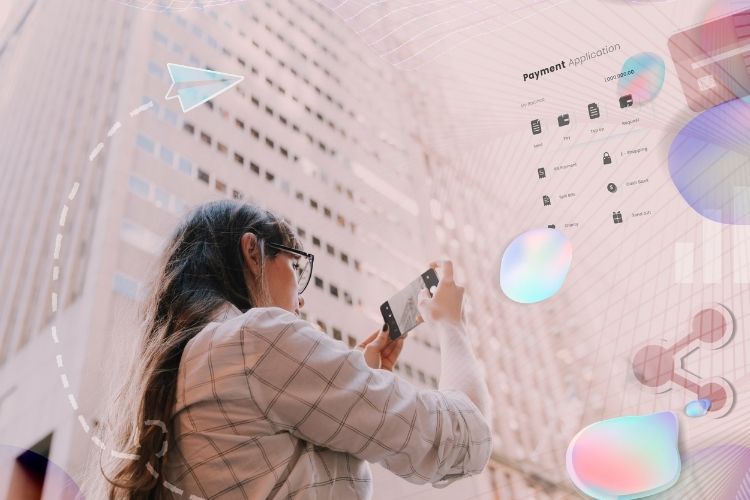
It can be said that AR has come a long way from its experimental phase. Presently, it is the growing technology that opened up to the ground realities. AR is used in retail and healthcare to integrate into customer experiences and employee training.
The evolution of AR stands for a paradigm shift in digital interaction. Rather than experiencing the digital world separately, people try to merge it with some aspect of real-life. Augmented reality uses information and graphics into the physical environment so as to better perform and engage..
Table of Contents:
What is Augmented Reality?
Augmented Reality (AR) adds digital content such as objects, images, or information to a real-world scene. It can be experienced either through a smartphone, tablet, or smart glasses. In contrast with Virtual Reality, which replaces the environment, AR enhances reality without subtracting it.
This difference gives AR just enough leverage to be infinitely more useful in everyday life. Customers can shop with virtual previews, while doctors look at anatomy topographies during procedures. Educators find AR so useful that they use it to create interactive lessons that students simply cannot ignore.
The Current State of AR
Since devices are becoming performant and networks insuring fast data transmissions, the adoption of AR is expanding. Mobile augmented reality technology is the most common form of AR, as practically any smartphone supports it. People nowadays do not even realize that working behind an app, gaming tool, or shopping tool is an AR setup.
Yet, smart glasses and headsets are quickly becoming the hottest tech. Designers are constantly working hard on bettering designs so that when commercialized, the gadgets are small, lightweight, and feature-rich. With this tilt toward wearable AR, sans-aiding digital overlays may become commonplace shortly.
Key Trends Driving AR
3D and AR Product Model Rise
Retailers replace static images with 3D product models that are interactive. Customers rotate and zoom and then place the item into real environments. This confidence-building approach that convinces a purchaser also discourages product return.
There is more engagement from the business side too through immersive shopping tools. Since enhanced sensors are in action, phones can detect surfaces with greater precision. Product placement that follows becomes, therefore, equally lifelike and natural.
Expansion of AR Glasses
AR glasses have been seen as one of the major hardware trends. Early gadgets were entertainment-oriented, but the current products go into work, communication, and productivity. This technology infuses digital surfaces in real-world surroundings.
Companies are still competing in this market based on lighter frames and battery life. The goal is to make AR glasses as commonplace as the smartphone. Very soon, donning digital overlays will be just as natural as wearing a pair of sunglasses.
Artificial Intelligence Enhancements
There lies a central role for Artificial Intelligence in AR’s future. Improving recognition of objects and also personalizing in real time and electric adaptation is what AI does. A real-time context-aware AR app, therefore, recognizes the environment and modifies content on the basis of context.
This brings about a more natural interaction between people and digital objects. For instance, an AR system might recommend arrangements for furniture, offer instructions on how to learn, or provide live medical insights. AI ensures that these experiences smoothly come alive and are highly relevant.
WebAR Growth
WebAR tries to make AR accessible without the need for specialized apps. They get to experience augmented content via a browser on their smartphones or tablets. Such barriers lessen adoption and makes businesses think twice about using AR.
WebAR is fast in reaching a wider audience because there is no installation process. Brands can embed AR into their websites, marketing campaigns, or QR codes. This easy accessibility further pushes for a rapid adoption of AR worldwide.
AR Across Industries
Retail and eCommerce
An AR tool in retail proves powerful for any online or offline shopping experience a customer wishes to shop for. A user can browse by trying out various products virtually, see how a piece of furniture fits in the house, or test a shade of lipstick on the spot. This prevents withdrawal and helps in decision-making.
From a retailer’s perspective, therefore, they enjoy receiving higher interaction and respecting fewer return requests. Customers engage with products for a longer period and are sure of their choice. AR continues to change business presenting and selling methods.
Marketing and Advertising
For augmented reality in business, marketers are now using AR to create interactive advertisements that immerse customers in brand stories and products. Virtual try-on and branded lenses are now commonplace.
This leads to stronger emotional bonds and better conversion metrics. Consumers recall interactive brand experiences much more than those experienced with static advertisements. This makes AR one of the biggest enablers of brand engagement in the times to come.
Healthcare and Medical Training
In the health sector, AR facilitates real-time overlays for intricate surgery. Hence, surgeons are able to get a glance at patient data, anatomical outlines, and vital signs without turning their eyes away from the complex procedure. This enhances the exactness and confidence with which they perform risky procedures. This promotes augmented reality in education.
They are also of great benefit to medical students in their AR simulations. Training with interactive 3D models is still training that assures safe practice of techniques. Thus, it lessens risk during the learning of such techniques and increases readiness when handling a real patient.
Education and Workforce Training
Augmented reality benefits classrooms by bringing them to life with immersive visuals and interactive lessons. Teachers use it to simplify complex subjects like science and engineering. Students remain engaged while learning abstract concepts more easily.
Hands-on guidance is provided for workplace activities through AR training. Employees practice skills and troubleshoot equipment while learning safety procedures with little supervision. This makes the workforce more efficient and cuts costs related to training.
Remote Collaboration and Communication
Through AR, a team or teams create working environments within shared digital or virtual spaces. Designers, engineers, and managers working in different locations view the very same model. Adjustments made in real time are instantaneously visible, and decisions are therefore made quicker.
In personal life, on the other hand, AR can offer holographic communication experiences. Friends and family appear as 3D avatars; hence, life-like conversations occur even if they are not physically together.
The Future of Augmented Reality
The future of AR will hence go into deep integration with present-day life. When the technology gets enhanced, the devices will shrink in size, turn into powerhouses of their own, and come down in price. Glasses, in the distant future, may replace the smartphone as the instrument for digital interaction.
In the future, AR will link with AI, 5G, and IoT in providing clever interaction. To get started on your AR journey, contact us! These existing technologies will provide immediate feedback, integration of live data, and seamless connectivity. This will entail the embedding of a digital layer right into reality.