
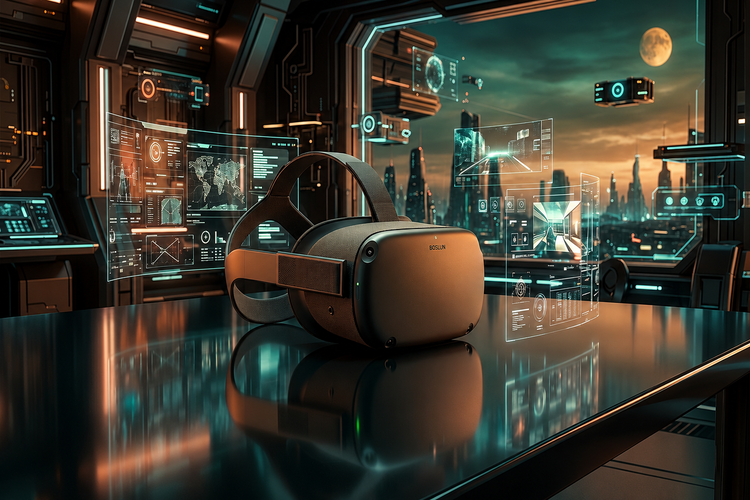
Virtual Reality is one of the latest innovations that change the way people experience their digital world. This technology enables users to enter a computer-generated reality that responds to their inputs and provides them with an immersive experience.
Table of Contents:
Definition and Overview
Virtual Reality is a technology that creates immersive digital experiences where you can interact with computer-generated simulations that are perceived as real. Unlike traditional modes of display, VR replaces your visual field with a virtual environment that transports you and puts you right in the middle of the action.
In essence, Virtual Reality Technology aims to trick your senses into perceiving virtual elements as real. By simulating a 3D environment and using audio, VR creates an embodied sense of presence, which is a feeling of being physically present and interacting with the surroundings in the virtual environment. This is in contrast to a traditional 2D computer interface that puts you in a position to look at something, not be in it.
Currently, VR has gone from being an experimental technology to becoming a multi-billion-dollar industry with applications in Gaming, Education, Healthcare, Productivity, and more. With new VR devices such as the Meta Quest 3 and Apple Vision Pro, VR experiences are now more accessible than ever.
History of Virtual Reality
The term Virtual Reality was coined by a computer scientist and entrepreneur Jaron Lanier in the 1980s. Lanier founded VPL Research, the first VR company in the world that designed and sold VR hardware. He also pioneered many VR concepts that are in use today. Many corporations such as NASA, automakers, and others were among the first to adopt VPL’s VR technology and systems to develop some of the earliest VR applications.
Key Milestones
The 2010s saw the resurgence of VR with the invention of Oculus Rift by Palmer Luckey. As a teen, Luckey built a prototype from off-the-shelf components that could deliver higher-quality VR at an affordable price. The project’s credibility skyrocketed after renowned game developer John Carmack joined the team. The company successfully raised $2.4M on Kickstarter in 2012, which led to the current VR era.
In 2014, Facebook acquired Oculus for $2B, indicating the tech giant’s interest in the potential of VR to drive the next phase of computing. The acquisition also spurred the entrance of other tech companies such as Google, Sony, Valve, Snapchat, Lenovo, and others into the VR space. Currently, Apple’s new Vision Pro in 2024 marks the end of the experimental phase and catapults VR to the established computing category. Presently, Virtual Reality and Augmented Reality are referred to as Spatial Computing.
How Virtual Reality Technology Works
Virtual Reality technology works by fooling your senses into believing that what you are seeing and hearing is happening in real life. For a convincing simulation, VR headsets had to overcome several challenges such as high-resolution displays, accurate spatial tracking, and 3D spatially rendered audio.
Head Mounted Display (HMD)
VR head-mounted displays or HMDs are the devices that give you a window into the VR world. This is the main component of a VR system which contains several other parts that work together to create an immersive visual and audio experience.
An important Features Of Virtual Reality is the use of OLED panels close to the eye in modern VR HMDs. They operate at 90Hz or higher refresh rates to avoid motion sickness and provide visual comfort while reducing input lag. The display technology works based on optical magnification via Fresnel or pancake lenses to create a wide field of view, with each eye seeing an image on the screen to form a stereoscopic image that replicates natural binocular vision.
Inside the HMDs are tracking sensors such as accelerometers, gyroscopes, and magnetometers that allow the headset to determine the orientation and rotation of the user’s headset. Additionally, most modern VR HMDs use inside-out tracking technology with a set of cameras on the headset. They use computer vision to track the user’s position in the real world to update the graphics and display in real-time.
For a truly immersive experience, hand and controller tracking is essential. Modern VR systems utilize a combination of sensor-based and computer vision-based tracking. In sensor-based VR systems, the controllers have built-in tracking sensors. In computer vision systems, the software tracks the position of your hands and recognizes your gestures.
Virtual Reality (VR) vs Augmented Reality (AR)
Virtual Reality and Augmented Reality are often grouped together under the mixed reality umbrella but have some differences. VR and AR both have similar underlying technological components but differ in the level of immersion they offer to the user. Understanding the differences can help you to know when to use each technology.
Differences between VR and AR
While VR completely transports you to another world, AR overlays digital elements on top of reality. A VR headset typically blocks your view of the real world as it provides you with entirely computer-generated visuals and 3D audio. With VR, you become part of an immersive and interactive virtual world that may take the form of a training simulation or game.
An AR headset, on the other hand, does not replace the real-world environment but adds digital elements on top of it. With AR, you can see the real world but with the addition of digital features such as animated elements, holographic projections, and data visualizations. These digital elements are spatially aware, which means that they can exist in the same space as real-world objects.
Similarities between VR and AR
The two technologies have some components that are similar. For example, both VR and AR devices use display screens and tracking systems. The main difference between AR and VR is the level of immersion, with VR being higher than AR. With VR, you are immersed in a completely different world as it replaces your real-world visual and audio perception. On the contrary, the level of immersion with AR is low as it only adds digital elements to the real world. With current VR headsets, you cannot see real-world objects, but with AR devices, you can.
Another distinction between the two is that VR is generally not spatially aware unless it is a mixed reality headset while AR is inherently spatially aware. In other words, digital elements in AR are aware of their position in real space, which makes it possible for the objects to exist and behave as if they are part of the real world.
In essence, Mixed reality is a term that refers to applications and devices that utilize aspects of VR and AR. It enables users to experience an environment where real-world elements blend with digital elements seamlessly. Unlike VR, mixed reality does not totally immerse the user in computer graphics but rather enhances the real world with digital elements. Additionally, unlike AR, mixed reality is more immersive as it enables the digital elements to interact with the real world.
Extended Reality (XR) and Spatial Computing
Extended Reality or XR is sometimes used to refer to the combined experience of VR, AR, and Mixed Reality. The term XR is a technical way of referring to VR, AR, and Mixed Reality technologies. With the recent launch of Apple Vision Pro, another term used to describe VR and AR is Spatial Computing. In short, Spatial Computing and XR refer to the same technology.
Spatial Computing is a buzzword that encapsulates all the immersive technologies such as VR, AR, and Mixed Reality. It is a term that describes a new era of computing where people can interact with computers in a 3D environment. The term refers to the convergence of digital and physical realities that is made possible by VR, AR, and Mixed Reality headsets. Similarly, XR is also a buzzword used to describe spatial computing by tech companies.
Virtual Reality Applications Across Industries
Virtual Reality is being adopted across a wide range of industries to change the way firms operate and transform consumer experiences. The applications of VR are becoming widespread as the technology continues to be adopted in sectors such as Healthcare, Education, Retail, Gaming, Entertainment, Remote Communication, Art, Cultural Heritage, and History.
Gaming
Gaming continues to be the dominant application of VR, as it enables game developers to create an entirely new category of immersive and interactive games. Virtual Reality is being leveraged to enable motion, which fundamentally changes the gameplay dynamics. It is this element that has led to the VR game category becoming a multi-billion-dollar industry.
Games such as Beat Saber and Pistol Whip use rhythm-based mechanics while titles such as Half-Life: Alyx represent the AAA VR game category. Other multiplayer VR games such as Gorilla Tag and Population: One have millions of users worldwide.
The competitive aspect of VR gaming is fast becoming a sport with new Esports categories being introduced. Some of the games such as Nock and DISC demand a high level of skill and coordination, which makes Esports events a true test of human ability and speed.
Education and Training
The EdTech space has witnessed the rise of several VR-based education startups that enable students to engage with a 3D environment that enhances human learning. Virtual Reality In Education has enabled companies to offer immersive educational content that helps students discover and pursue careers through VR training. VR platform provides the skills and credentials needed by students to secure good jobs and support economic mobility through the modern workforce education platform.
Research indicates that VR training and education are more effective than traditional learning methodologies and have higher retention rates.
Retail
The retail industry is adopting VR to create immersive brand experiences that enable them to connect with consumers on a deeper level. Some of the most exciting uses of VR are being driven by retail companies that use the technology to tell brand stories. Ulta Beauty uses VR brand experiences to entertain their clients and promote their brands in an innovative way by featuring influencers such as Ariana Grande.
Luxury fashion companies such as Gucci create immersive digital content that enables them to engage customers globally. Their recent project, The Gucci Story for Apple Vision Pro, transports users into the brand’s world, where they interact with and discover the latest collections.
Immersive applications enable these brands to create brand affinity with their consumers by giving them a memorable experience that is impossible with traditional marketing. With VR, brands can offer consumers access to rare and exclusive content that can only be found online. It also makes it possible for retailers to replicate in-store experiences for clients worldwide through virtual pop-up stores and immersive brand experiences.
Remote Communication
The next evolution of remote communication is being enabled by the latest VR developments. In a recent podcast, Lex Fridman interviewed Mark Zuckerberg in VR after hosting a podcast that was captured in VR. According to Fridman, the communication feels real as he said, “I’m forgetting that you’re not real. This really feels like we’re in the same room. It feels like a totally fundamentally new experience.”
Meta Workrooms, Apple Personas, and Spatial.io enable remote communication that feels more personal than video conferencing tools such as Zoom. VR communication tools enable users to communicate virtually face-to-face while supporting meetings, presentations, and remote collaboration.
Art
VR presents a whole new way of experiencing art, which is why many artists are using the technology to create new works. The 3D immersive environments of VR open up new possibilities and allow artists to explore unique ways of showcasing their work. It is a medium that enables artists to connect to their audiences in ways that have not been possible before.
Examples include The Museum of Other Realities, Modules, Lucas Rizzotto’s VR experiences, and Notes on Blindness.
Culture, Heritage, and History
VR is playing an important role in preserving and promoting cultural heritage and history. The technology is being used to document and promote indigenous cultures while immersive historical documentaries allow audiences to experience significant events from entirely new perspectives.
Healthcare
Healthcare companies are adopting VR for diverse applications. Medical device companies such as Medtronic use VR to train doctors, while others such as Daiichi-Sankyo and Abbott use VR to improve healthcare experiences through patient education, product training, and onboarding.
Social Platforms
VRChat and Rec Room are among the leading social VR platforms, enabling millions of users to interact, socialize, customize avatars, and attend large-scale virtual gatherings.
Entertainment
Entertainment is another sector transformed by VR. Content creators use immersive technology to recreate concerts, sporting events, and other experiences through 360-degree video that places audiences at the center of the action.
Military
VR supports military applications through immersive combat simulations, emergency preparedness, planning exercises, and AI-powered visualization platforms developed by companies such as Meta, Anduril, and Palantir.
Fitness
VR fitness applications gamify workouts through boxing, dancing, and exercise experiences. Popular platforms such as FitXR and Supernatural help users remain motivated while achieving their fitness goals.
Virtual Reality and Artificial Intelligence
Virtual reality is currently intersecting with artificial intelligence to enable innovative applications and use cases, representing one of the most exciting opportunities for the future of VR.
Computer Vision and Machine Learning
Computer Vision and Machine Learning have powered much of the research behind VR tracking technology, enabling accurate positioning, movement tracking, and immersive interactions.
AI-Powered Experiences
AI-powered experiences are beginning to appear in VR through intelligent non-player characters and real-time content generation, creating richer and more dynamic virtual worlds.
AI-Powered Development and Content Creation
AI is enabling faster Virtual Reality Development by accelerating content creation, improving production workflows, and allowing smaller VR studios to compete more effectively with larger organizations.
Challenges of Virtual Reality
Virtual Reality technology currently faces several challenges that must be addressed before achieving widespread adoption.
VR Motion Sickness
Motion sickness remains one of the biggest challenges for VR. Higher refresh rates, lower latency, and comfort settings have significantly reduced the issue, although some users continue to experience discomfort.
Privacy and Security
VR systems collect significant amounts of biometric and behavioral information. Protecting this data through strong privacy policies and security measures remains essential to maintaining user trust.
Safety and Harassment
VR platforms have introduced body boundary systems, muting, blocking, and reporting tools to improve user safety and reduce harassment within immersive environments.
Mass Adoption
VR still faces challenges reaching mass adoption due to the lack of a universal “killer app” capable of delivering broad everyday value similar to smartphones or productivity software. As hardware and software continue to evolve, broader adoption is expected.
Future of Virtual Reality
VR technology continues to evolve rapidly, creating new business opportunities across industries while driving innovation in immersive computing.
Technological Advances
New generations of VR hardware continue to become lighter, more powerful, and more versatile, enabling developers to build increasingly immersive applications with every release.
Market Growth and Opportunities
VR is experiencing strong growth across consumer and enterprise markets. Significant investment from companies such as Meta, Apple, Google, and ByteDance continues to accelerate innovation, while the convergence of VR with AI, AR, robotics, and blockchain technologies is expected to unlock even greater opportunities.
Wrapping Up
This ultimate guide has explored the evolution of Virtual Reality, how the technology works, its applications across industries, current challenges, and future opportunities. As immersive technologies continue to advance, VR is expected to become an increasingly important part of both enterprise innovation and everyday digital experiences.
If you are looking to create immersive Virtual Reality Experiences for your organization, reach out to our team to discover how the right VR solutions can help bring your ideas to life.