
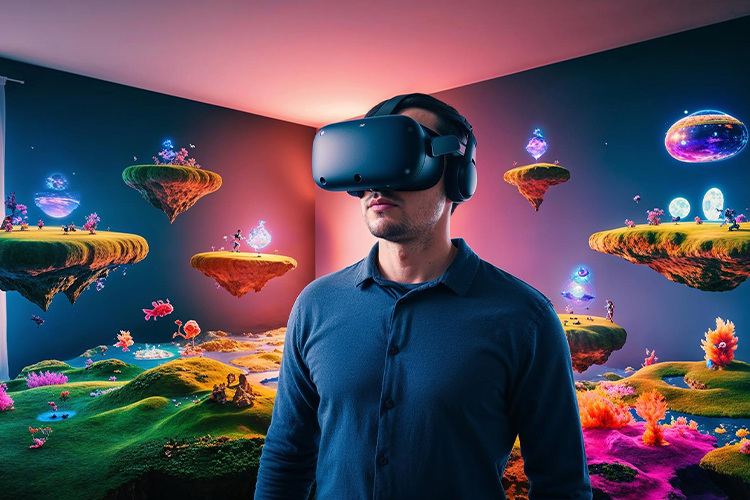
Even if you follow science and technology news from a distance, you may be familiar with Mixed Reality (MR). However, what is it? How does it operate? And why is it important?
Let’s investigate the solutions.
Table of Contents:
Recognise the Continuum Between Reality and Virtuality
The transition from actual to virtual reality is depicted by the reality-virtuality continuum. Real and virtual aspects interact to varying degrees at different stages of that transition.
Real Reality (RR), or the actual world as you know it, is at one end of the spectrum. Virtual Reality (VR) is at the opposite extreme of it. With no reference to the actual world, virtual reality (VR) produces a simulated environment that captivates the user’s senses. Between RR and VR are augmented reality (AR) and augmented virtuality (AV).
Although AR overlays the real environment with sounds, images, and other aspects, the virtual and physical worlds stay distinct. Although they cannot interact, an observer can experience both virtual and actual aspects in real time. Since humans are yet unable to completely escape into virtuality, AV should theoretically overlay Real Reality atop Virtual Reality.
Conversely, Mixed Reality merges the virtual and physical worlds. Real-time interaction between virtuality and actuality occurs in MR. Through advanced imaging and sensor technology, MR allows users to interact and manipulate both virtual and real-world environments or items.
With its ability to instantly apply digital information to a worker’s real-life experience, this technology has the potential to completely change the workplace. This feature illustrates why corporations and researchers are drawn to the majority of MR solutions.
The general name for all realities as a continuum is extended reality (XR).
How Does Mixed Reality Work?
The merging of the digital and physical worlds creates mixed reality. MR is diverse not just in terms of virtual and real-world experiences, but also in terms of the technologies that power it. Each of these technologies has useful applications in several fields and ranges from portable gadgets to whole rooms.
Let’s examine.
Head-mounted Display (HMD)
An HMD projects an image directly into the user’s eyes using a tiny display optic in front of each eye. This gadget is worn over the head or as a component of a helmet. There are numerous applications for HMD in engineering, gaming, entertainment, medical, and aviation. The majority of its users are in the entertainment sector, as major tech firms create HMDs to enhance their current offerings.
Unfortunately, because they don’t communicate with the real environment, these head-mounted displays are entirely digital. Nonetheless, a popular augmented reality head-mounted display performs better in business settings. For instance, doctors can access real-time insights through medical apps on Microsoft’s HoloLens. HoloLens overlays critical information on top of the real environment in engineering.
Head-up Display (HUD)
Users can examine information on the HUD without turning their heads. Three components make up the transparent device:
A projector, which superimposes the graphics on the display, The computer integrates the other parts, and the combiner is the platform on which the graphics are projected. Additionally, it does all calculations and modifications in real time.
One of the earliest HUD applications in automobile transportation was Pioneer’s Heads-up system. A display that provides the driver with roadside instructions has taken the place of the driver-side sun visor.
Since then, various head-up displays have been added to certain models by manufacturers like Audi, BMW, and Toyota.
Mobile Devices
Computer-generated interfaces on LED screens are no longer found on mobile devices. These days, augmented reality application development toolkits are available for smartphones and tablets.
The first widely popular augmented reality mobile game was Pokémon GO. It received 800 million downloads after its July 2016 release. The integration is expanding beyond the use of entertainment apps.
Discover how to make your own game that is similar to Pokémon GO.
Google Maps was updated to allow AR navigation. Directions on streets are superimposed in front of the user using the new function. The software business has added the ability to overlay translated text in more than 20 foreign languages on physical writing to its translate app.
Cave Automatic Virtual Environment (CAVE)
Projectors are aimed at three to six walls in a small space to create the immersive virtual reality environment known as the Cave Automatic Virtual Environment (CAVE). When employing the CAVE, the small area is usually encased in a bigger space that needs to be dark.
The user is given a perspective that mimics the real world thanks to the 3D and surround sound that go with it. Since its inception, CAVE systems have served as a testing ground for engineers who have created and evaluated a number of prototypes.
Before spending money to create a real prototype, product designers typically test their designs. Practical testing on intangible items, such as tiny settings, is made possible by this procedure.
The same researchers who created the CAVE later published the CAVE2, which addressed the limitations of the first CAVE.
Advantages of Mixed Reality
The advantages of mixed reality are what set it apart. Let’s examine a few of them.
Faster Quality Assurance Process
On-site teams can reduce errors, promote brief communication loops, and check the quality of their work using mixed reality. By enabling visual examination of the constructed product in real time, it can also aid in integrating quality assurance into the production process.
For example, Airbus claimed that the time needed to examine A380 fuselage brackets has decreased from three weeks to three days since implementing Mixed Reality in its production facilities.
Decrease in Maintenance Requests
The use of antiquated manuals by organisations is gradually becoming obsolete. Mixed reality is increasingly being used to reduce maintenance call-out times. For instance, ThyssenKrupp, a manufacturer of lifts, gave its engineers HMDs. These screens give engineers the most recent data.
It also provides a hands-free way to quickly contact an expert. In short, an engineer can share the same view with the remote expert on the other end of a help line call.
This adaptability enables the specialist to provide guidance and solutions without risk of misunderstanding.
Advancement of Employee Training
Employees can attend training sessions or receive information via mixed reality rather than poring over multiple manual pages. Training sessions can take place on the job, which saves time and money when developing training modules. Check out the INVISTA case study to learn more about a successful XR training scenario.
For example, a coaching professional can pre-record a module, which will be kept in a training library for employees.
Reduce the Shortage of Skilled Labour
Between 2018 and 2028, 2.4 million jobs could become unfilled due to an impending skills shortage. Employers can take action now and preserve key talents by utilising HMDs for remote help as this threat approaches. Employers can incorporate both new and familiar technologies to attract younger workers and fill open positions without worrying about hiring people who lack the necessary skills.
12 Practical Uses for Mixed Reality
Despite being relatively new, mixed reality is already becoming more and more popular in a variety of sectors. Here are a few examples of how this technology is used in the real world.
1. Production
Few technology can match Mixed Reality’s advantages in production. Engineers and industrial teams may immediately exploit the data collected by artificial intelligence (AI) and the internet of things (IoT) thanks to this technology. While on the job, employees can view and utilise the data in real time.
As he moves around a factory, an inspection worker could use MR to visually get information about energy use and observe how different parts of a device are functioning. Additionally, if maintenance or inspection personnel encounter an odd issue, Mixed Reality enables them to consult with a distant specialist.
Manufacturing teams can also design virtual signals and instructions that others can follow. For instance, when a manager draws attention to a specific area or gadget, his employees are aware that it needs their focus.
IoT-enabled gadgets, such as helmets, headsets, and glasses, are also supported by mixed reality. These devices can communicate with other devices, retrieve data from their sensors, and share the data gathered via a network. These tools enable employees to make more accurate forecasts and prompt judgements.
2. Space Science
Because OnSight made it easier for scientists and engineers to virtually explore Mars, it was named NASA’s Software of the Year in October 2018. Microsoft and NASA’s Jet Propulsion Laboratory worked together to create this mixed reality software. Besides researching the geology of Mars, InSight allowed scientists who were spread out geographically to visit, interact, and converse with each other in real time.
3. Automobile
The advantages of mixed reality are also being felt by the automotive sector. The Mercedes-Benz Global Training in 2018 demonstrated how HoloLens may increase the productivity of engine manufacture and brake assembly.
4. Aviation
Mixed-reality-based aviation solutions can boost digital manufacturing strategy and offer real-time immersive training. In June 2019, Airbus put this notion to the test through their partnership with Microsoft. Microsoft’s HoloLens 2 headset was tested by the aircraft maker in a Mixed Reality setting. Training, design, and manufacturing were among the test domains.
BAE Systems, which produces the electric propulsion systems for HybriDrive buses, is another illustration. To develop Mixed Reality solutions that improve the productivity of Firstline Workers, BAE collaborated with PTC, a Microsoft Mixed Reality Partner.
BAE and PTC developed a comprehensive, step-by-step training manual for Microsoft HoloLens using ThingWorx Studio. Workers were given instructions on how to put together a green energy bus battery in the guide.
5. Holograms
People can create holograms to display scenes or items that have never been before thanks to MR. For the Sundance Film Festival that year, the Mixed Reality startup 8i debuted a lifelike hologram of John Hamm in January 2016.
Additionally, the business produced a hologram Buzz Aldrin image for South by Southwest (SXSW). 8i even created an application that lets users create their own 3D animations.
Celebrities are also participating in this trend. For her 40th birthday, Kanye West sent his wife, Kim Kardashian West, a hologram of her deceased father.
The Robert Kardashian hologram was made by Kaleida. Kim tweeted the video because she was so happy.
6. Education
Through interaction with virtual objects, certain MR apps can aid in students’ learning. Others, such as HoloAnatomy, enable educators to teach pupils from a distance.
The app, which was created by Cleveland Clinic and Case Western Reserve University, teaches medical students anatomy using Microsoft’s HoloLens. It even took in the 2016 Jackson Hole Science Media Awards’ Virtual Reality & Augmented Reality prize.
GIGXR’s immersive learning mixed reality platform for healthcare is also causing a stir. HoloPatient and HoloHuman, two of their greatest programs, use realistic 3D simulations in a well-organised physical environment.
7. Entertainment and Sports
Fans of entertainment and sports can also benefit from Mixed Reality. The PGA Tour created an app years ago that allowed golf course enthusiasts to experience them in three dimensions.
The Golden 1 Centre demonstrated that there were alternative ways for basketball fans to enjoy a game. Fans had the opportunity to see live data interactions at the Sacramento Kings’ home.
Digital agendas, player information, and ordering drinks and items to be delivered to their seats are all examples of these interactions. This includes a growing range of Mixed Reality Games.
8. Healthcare and Medicine
Medical practitioners can examine and share patient data or records in a more engaging way with Mixed Reality. They can benefit from improved imaging as well.
Instead of zooming in on certain areas of a scan with a keyboard and mouse, they can employ Mixed Reality to monitor a user’s gaze and even react to movements. Medical practitioners can then analyse an image in a more realistic manner.
Healthcare workers can send and receive voice communications more quickly because Mixed Reality devices can record and exchange voice communications.
9. Remote Work
Through Mixed Reality, remote workers can interact with clients or other employees. Through the use of real-time translation applications, users can even get beyond language restrictions. To train engineers without being physically present in the hangar, Japan Airlines uses HoloLens. This highlights the power of Mixed Reality Applications.
10. Railway Maintenance
Because railway infrastructure and facilities are always changing, engineers and maintenance crews must be able to swiftly pick up new technology. Deutsche Bahn joined the Microsoft Mixed Reality Partner Program in response to this demand.
Later, the German railway business developed an Mixed Reality App that would more effectively train engineers on railway parts and maintenance.
11. Engineering and Construction
Inspectors and engineers can monitor their sites using a visual headpiece in place of working physically, which enables them to spot issues or work in real time with personnel on the site. An app can connect 3D content from the screen to the building site, similar to Trimble Connect for HoloLens.
The software offers project management, coordination, collaboration, and 3D design review procedures.
Put Mixed Reality to Work
Although the applications for MR technology are astounding, they are only the beginning because the technology is continually developing. We can take use of the experience MR is giving us in the interim, but only time will tell where it will lead us. For businesses and innovators, exploring MR Services Malaysia can offer exciting opportunities. Utilize the potential of the Mixed Reality Portal to your advantage.
Contact us to explore how Mixed Reality can elevate your business, training, or creative project. Whether you’re interested in developing a Mixed Reality App, exploring innovative Mixed Reality Applications, or leveraging expert MR Services in Malaysia, we’re here to help.