
Branding is often misinterpreted as a just a logo design, business card or nowadays, as a website.
In reality, Branding is an experience.
I have met countless business owners who are preparing to enter the market, but they are not sure whether they are marketing or creating a brand for their products.
Therefore, we first need to discuss what the brand covers, especially small business brands, and then we will discuss how to seize the opportunity.
Table of Content:
- How will we distinguish between Branding and Marketing?
- Then, what is Branding?
- Why is Branding important?
- Understanding the Mechanics of Consumer Memory
- How to know that your Brand experience design has occupied the long term memory?
- Stage 1 – Keep a track of the customer’s journey
- Stage 2 – Make a connection with the user’s lifecycle and their memory
- Stage 3 – How to deliver indelible imprint of your brand
- What is the right way to Brand?
What is Branding for the user?
Website design, corporate logo and color scheme-If you think that designing a beautiful website, choosing the best color for the website or designing the most suitable logo is the first step in your branding, then I must say that you are misunderstood.
Being highly active on social media platforms is a necessary condition for yourself and your website brand, as it will help to develop a niche market.
You need to improve the viability of SERPs and conduct strict advertising campaigns.
If you consider brand promotion as all of the above techniques, you must fire the fact investigator or strategy maker because this is not brand promotion.
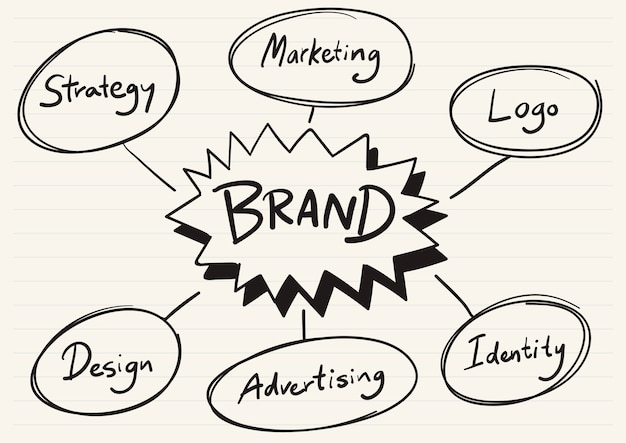
How will we distinguish between Branding and Marketing?

Picture source from https://inkbotdesign.com/
Many people confuse the difference between marketing and branding. Marketing is obviously a strategy used to promote your business in order to get rewards.
In this strategy, you can use PPC, SEO, mobile, social media and other tools as well as brochures, signs and other methods to provide users with the brand.
Among them, the brand is very different from it, because it is a kind of culture, is the information about your brand, which helps spread your business.
Then, what is Branding?
In relation to the above statements, it is important to give you a definition of Branding.
On that note, it should also be stated that a designer cannot “make” a brand – only the audience can do this. A designer constructs the foundation of the brand.
Why is Branding important?
Branding holds much more gravity in business than we probably think, therefore there is a lot of written discourse over branding.
So, in essence, a ‘brand’ is a service or product which is personified as per the perceptions of the users/viewers.
This statement automatically raises eyebrows as now users are in charge of the complete brand formation and a designer has no role in it.
This is not so, as designers are the ones which lay the edifice of building human branding.
Understanding the Mechanics of Consumer Memory
Consumer’s memory and the level of their attention plays a crucial role in the proper branding strategy of your business.
Seeking the attention of the audience in return depends on the emotional connection and engagement factor your brand has – and it scientifically can be calculated by measuring the timing of the rhythms of neurons.
Furthermore, there is also a life span of every kind of memory, short memories have a life span of some milliseconds, but there are memories which last for hours, days or even several years, called long-term memories.
When it comes to creating memory, it needs several interconnected activities in several parts of the brain.
This means that when building a brand for a company, you can’t just use an ad-you need to use a series of interrelated actions to create a storage space in the user’s mind.
Scientifically speaking, there are different types of neurons for processing specific information.
When one neuron sends information to another neuron, information flow occurs, which is what makes the memory more fixed in the brain. This is similar to practice, the more you practice a particular subject, the more proficient you will be in that subject.
Likewise, the more signals you send, the stronger the connection will grow.
We can deduce that a memory space is created via recognition, but in order to increase the time span of the existence of a memory comes just by repeating the process again and again.
The more we experience a particular thing the more we tend to remember it.
As a product branding leader, what you need to do is carve your brand into the long term memory of your customers.
Once you have done that, it is easy to make it stay there for a long time. After the recognition test, it was seen that imagery and sounds which were important were recognised even after many decades.
This is certainly applicable to your brand with the message you want to deliver.
There are several elements attached to a brand, and after breaking these elements, the brain starts to make a visual pattern and recall the previous experience encountered which is stored in the memory earlier.
When a human brain watches something, it immediately tries to recall the memory so as find out whether they have had an experience prior to this.
In order to rectify it, a test of MRI was conducted at ISMAI and the Technical University of Lisbon, in which they showed a group of logos (real and fictitious) to the users and then they noted their brains activity from MRI.
After watching the real logos the additional part which contributes to the memory of the brain was activated, wherein it did not happen when the fictitious one were shown.
This reveals that the memory connections are built by repetitive exposure to the brand.
Adding on to this there was another test of MRI, which revealed that familiar brands also account to initiate signal of biological reward further activating the dopamine system which augments motivation and pleasure sensors.
How to know that your Brand experience design has occupied the long term memory?
In order to know that whether your brand has occupied a long term memory slot in user memory, you need to carry an audit.
As this is a common affair in marketing which is carried by analysing elements such brand imagery, strategy, adherence received across different places and channels.
This stereotypical process does not focus much on matters pertaining to the memory of the users.
In order to focus on memory you can follow the following steps:
Stage 1 – Keep a track of the customer’s journey
In order to review your brand and focus on memory, you need to start with an understanding of consumers.
You need to understand the user’s background, their preferences and intentions to buy the brand.
This will further guide you to follow a more general communication awareness, purchase and repurchase process, and it can also be further shaped into specific interaction phases and sales cycles.
Stage 2 – Make a connection with the user’s lifecycle and their memory
There is no gainsaying that managers do test awareness of branding, which helps to understand the ability our brand has to set foot in customers memory.
But what we actually miss is the ability to get those instantaneous moments that occur daily which evokes the identity of a brand.
Hit the iron when it is hot!
You need to understand that there are various factors which affect the mindset of users through every decision-making phase of the purchasing lifecycle.
You need to know their mindset as soon as they come down to you to purchase a product. You need to know their comparative analysis and why they have opted for you and left your competitor. What are the units which embark on a purchasing process.
Here you need to understand what all sentiments evoke a customer to start making a purchase.
Stage 3 – How to deliver indelible imprint of your brand
Ideas are easy, implementation is hard
The entire analysis will help you find out what effects you need to create for your audience in order to persuade them to buy from you.
After collecting all the information, you need to systematically arrange the information in order to leave an indelible mark on the product or service.
What is the right way to Brand?
Before jumping into the marketing phase of branding, you need to consider certain branding prerequisites.
To begin with, you need to answer some of the most rudimentary questions behind your product or service.
There are a few things you need to think about before planning your online marketing strategies, such as:
- • Clearly state your existence: The first step is to state the reason for your existence. You need to write a mission and vision for yourself.
- • Choose the method of disseminating knowledge: The next step is to know in which area you intend to provide valuable services. This will help you understand your brand type and help you come up with outstanding brand values, information and ideas.
- • Cultivate a useful work culture: It is necessary to cultivate a useful work culture, and more importantly, talk about it in public. The culture you have can help you establish a good brand image.
- • Share what you provide: This is the brand promotion stage, you need to make adjustments to promote your brand. Here, you need to spread the brand and create demand to use it.
Article source from : https://inkbotdesign.com/