
Table of Contents:
Introduction to 3D Scanning
3D Scanning is a prominent technology nowadays. For example, game and VFX studios are taking a step away from conventional modeling and are instead using 3d scanned models for their scenes to get better results in less time. The car industry has also adopted this technology to great extent. For instance, in transportation design, they first make a concept car out of clay and scan their surfaces to create 3d surfaces using soft wares like Alias or Catia through retopology. 3d scanning is also used to print 3d scanned objects.
In this article we will explain answers to all of your questions about 3d scanning.
What is 3D Scanning?
3D scanning is a fantastic technology that allows us to capture the real world with amazing precision and depth. 3D scanning is the process of capturing the shape of an object, person, or a place using laser scanners or photogrammetry. Using a laser scanner to capture real-world objects or environments is as simple as shining a flashlight on them, with the exception that a laser scanner uses lasers to paint the surface of an object with thousands of unique points. Using algorithms, these points are converted into a digital 3d model that can represent the scanned object or environment with outstanding precision.
3D scanning connects the real world to the digital realm in the most amazing way. You can now use software and computers to manipulate and reproduce real-world objects in the digital world. 3D scans have had a major impact on industries such as design, engineering, archeology, healthcare, entertainment, and more.
Some of the most interesting applications of 3D scanning include capturing historical artifacts for research, inspecting complex machinery parts for engineering analysis, building virtual prototypes for entertainment and design purposes, and more. This technology not only captivates us but it also encourages us to think about how objects around us behave.
New and exciting applications for 3D scanning are being discovered every day. And the best part is that this technology is set to change the world as we know it in the near future. The combination of this technology with other technologies such as VR and artificial intelligence will lead to very exciting discoveries.
Moreover, as this technology develops and becomes more accessible to the public, it will become a vital tool on the path of innovation, design, and engineering.
Difference Between Long Range And Short Range 3D Scanning
Most scanners have a range of more than one meter. Long-range scanners are typically used to capture objects and environments with great precision and at a larger scale. They are mainly used in civil engineering, mining, and other industries to capture underground structures, while short-range scanners are used to capture objects with extraordinary precision, such as small objects that require additional attention or intricate measurements.
Short-range 3D scanners have a shorter range, usually less than a meter, and usually employ laser triangulation to capture objects with extraordinary accuracy, down to the sub-millimeter range.
Evolution Of 3D Scanning
The evolution of 3D scanning has been truly remarkable, with an incredible array of different technologies being developed to meet the needs of different industries. Below is a general overview of the 3D scanning evolution:
1960s–1980s: Development of fundamental 3D scanning methods such as laser triangulation and photogrammetry, 1980s–2000s: Introduction of commercial 3D scanners and photogrammetry software packages that make 3D scanning accessible to the public. For example, in 1980, Yoshiaki Kakino and Hiroaki Kobayashi introduced the first ever commercial laser scanner that could capture 3D content using laser triangulation, 2010s-present: Advancements in display technology, sensor technology, and 3D computer graphics have enabled the development of new high-resolution 3D scanners, as well as the integration of 3D scanning and 3D printing technologies.
How Does A 3D Scanner Work?
A 3D scanner works by capturing an object’s shape digitally. Just like an artist, a 3D scanner paints an object. It uses laser beams or light to capture the geometry and shape of an object or surface.
A 3D scanner uses sensors and/or photo cameras to pick up this light, bounce it off an object, and calculate the distance between the scanner and the object to capture its shape. The resulting images are then processed in software and combined to create a digital model.
Like an artist, the software now scans an object and creates a digital painting of the object using 3D computer graphics algorithms.
Note: Today we are using different 3d scanning technologies. Let’s discuss about various technologies which are generally used for 3d scanning, and we’ll discuss all the 3d scanning process.
1. Laser 3D Scanning
Laser 3D scanning is the most commonly used 3D scanning technology. These are generally used to capture precise digital replicas of objects in real-world scale. They also tend to capture the most detail from scanned surfaces and allow users to output highly accurate point clouds.
This technology is optimal for objects requiring precise measurements even with conventional methods. Even with standard methods, it will be impossible to achieve the precision that this technology can offer.
Laser scanners are used in a variety of industries such as construction, manufacturing, and archaeology. This technology is used to capture the dimensional accuracy of objects to perform quality control, reverse engineering, and architectural restoration among other applications.
In laser scanning, laser dots or lines are used to paint an object and then a sensor measures the distance to the object. After processing, a triangulated mesh is produced.
2. Photogrammetry
Photogrammetry refers to using photography to make 3D models and measurements. Photogrammetry is a method that generally makes 3D models from a set of photos that are taken from different angles.
Using these photos and mathematical calculations photogrammetry works out what the 3D model of the image looks like. Photogrammetry can be used to create 3D models and 2D images that are very realistic of the actual thing.
However this method is highly inaccurate and you would require excellent photogrammetry software with a robust and accurate feature matching algorithm.
3. Structured Light Scanning
Structured light scanning is another 3D scanning technology which is used to capture 3D images of objects. This 3D scanning technology is generally used in 3D Scanning Services.
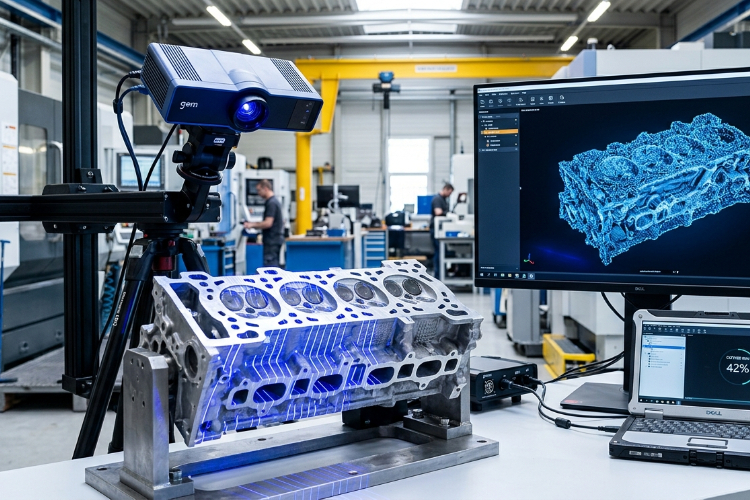
This technology scans objects with structured light projections and captures the pattern of light being reflected from the object using cameras to form a 3D model of the desired object.
This method is very quick and accurate for a variety of applications. Some of these applications include product inspections, design and prototyping, and medical imaging.
4. Time-of-Flight (ToF) Scanning
Time of flight scanning is a 3D scanning technology which is used to capture 3D images of objects. This method is based on the distance between an object and a scanning sensor.
This technology works by sending out a laser or light from the scanning sensor towards the object and then measuring how long it takes the light to reflect from the surface of the object back to the sensor.
Once this distance is calculated, a 3D image of the object is formed.
How To Use 3D Scanning?
Below are the steps on how to use 3D Scanning Solutions:
Make sure that your object is clean and set on a contrasting background so that it captures well.
Make sure your scanner is set to the right distance. Based on a 3D Printer Scanner Malaysia range move it to the appropriate distance.
Slowly move around your object until it captures all the surfaces. Make sure to capture all the nooks and corners. For large objects, make sure you move the scanner around the object and capture it at different positions and make sure that there is some overlap. You can then merge the two captured images.
Once the 3D scanning process is complete you can then edit it and create your desired model.
After editing, you can then export your model as an STL file or any other file type of your choice.
Benefits of 3D Scanning
Accuracy and precision: 3D scanners capture the exact details of any object with incredible precision allowing engineers and designers to take accurate measurements from the scan.
Time and cost saving: 3D scanning has replaced many conventional methods of measurement which can save an incredible amount of time and money.
It has a wide application: 3D scanning technology has a wide range of applications in different industries including health, archeology, and entertainment.
Improves quality control: With this technology you can accurately measure the dimensions of manufactured parts.
It improves reverse engineering: Having a 3D model of any object makes it easy to reverse engineer anything since it captures the exact dimensions of any object.
Limitations of 3D Scanning
The scanner must have a direct view of the objects that need to be captured. For instance, the scanner will not be able to capture the internal geometry of an object because it cannot penetrate objects and capture the images.
With optical 3D scanners, there are a number of properties which have an effect on how well the object can be captured. For instance, dark, shiny, or transparent objects might be challenging to capture. However, these challenges can easily be overcome to ensure that the results you get are outstanding.
Resolution and precision: The accuracy of the results you get when using a 3D scanner will rely on a number of factors including the technology used and the quality of the scanner. Generally, it can be challenging to achieve high levels of accuracy when scanning small objects.
It is generally challenging to 3D scan objects outdoors. This is because of the changing environmental conditions.
It mostly relies on post-processing: 3D scanning requires a lot of post-processing to get outstanding results. This process also takes a lot of time. The merging process of the images captured requires advanced software and expertise to ensure that the final 3D model is of good quality. These steps are crucial and should not be overlooked.
What Are The Applications Of These 3D Scans?
3D scanning can be applied in a variety of industries. Some of the industries which are greatly impacted by this technology are discussed below:
Industrial Design and Manufacturing
In this field, Industrial 3D Scanning is used for reverse engineering and inspection processes. This technology also allows companies to develop 3D printed prototypes.
Using this technology, manufacturers can digitize physical objects making it easier for them to design and produce new products. Therefore, it has helped companies reduce the time it takes to design and produce products as well as lower production costs.
Healthcare and Medicine
This technology is used in a variety of applications ranging from medical modeling, orthopedics, and prosthetics.
Medical modeling allows doctors to make better decisions when determining the most appropriate medication or surgery that will help patients be free from disease.
For instance, dentists use this technology to create 3D dental models which can be used to make dental crowns, orthodontic appliances, and more.
Forensic Science
3D scanning plays a critical role in crime scene reconstruction. This is done by capturing and analyzing 3D scans of the crime scene and suspect’s faces.
Crime scene investigators can use this technology to ensure that evidence is captured and preserved. In addition, forensic scientists can use this technology to digitally document a victim’s skeleton and recreate the skull.
Cultural Heritage
This technology has played a significant role in 3D scanning of artifacts, buildings, and 3D printing them. Therefore, various archaeological sites and museums have used this technology to digitize different artifacts.
Conclusion
3D scanning is a new and exciting technology that acquires 3D images and helps manufacturing industries around the globe to create amazing digital replicas of different objects.
Laser, video, and structured light scanning have revolutionized the way we perform different activities ranging from design to manufacturing. In addition, photogrammetry has made it possible for photographers to take amazing and extraordinary photos.
Each of these scanning technologies works a little bit differently and for different purposes. This technology has had a great impact on the world of manufacturing and design by enabling industries to come up with more accurate products and services.
However, there is a great downside to using this technology. Since industries have to purchase different 3D scanners for different purposes, it might still be costly.
If you are a professional and you would rather focus on your work and leave the 3D scanning to professionals, our expert team is here to help you. Instead of purchasing 3D scanners, you can connect with us and let us help you with your 3D scanning needs.
Let us help you innovate and bring your ideas to life much faster.