
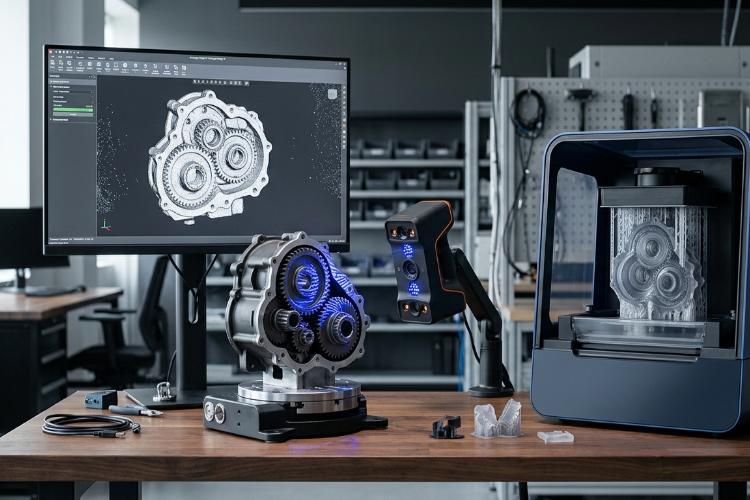
Using 3D Scanning And Printing To Recreate Objects
Reverse engineering is a powerful way to create digital designs from a physical part, and can be a valuable tool in your prototyping toolkit alongside technologies like 3D Scanning and 3D printing.
Quick measurements of tricky shapes come easy with 3D Scanning Solutions – suddenly, real-world models flow fast into your designs. Because they record actual forms, adjustments happen live, letting custom 3D prints slot neatly onto any pre-existing item. Jigs made by printers guide tools like drills or blades again and again, exact each time, especially useful when glue holds pieces together. Masks shaped tightly through printing serve over and over during tasks such as etching, spray work, or blasting.
In this guide, we’ll walk through the step-by-step reverse engineering process for an aftermarket digital gauge and explain how to scan a part for 3D Printing, with tips along the way for using the right reverse engineering tools, from CAD software to resin 3D printers.
Table of Contents:
Physical To Digital Shift With Meshes And Solids
What trips many folks up when going from real-world items to digital versions? A core mismatch shows up between two kinds of 3D forms – meshes versus solids. These formats just do not line up well, causing frequent roadblocks.
Triangles stuck together along their edges form what we call a mesh. These show up as the primary result from every 3D Scanning Services made. Printers built for three-dimensional work usually read them just fine – especially when saved as STL files. The outer skin of an item gets mirrored by these triangle networks. They map only where each flat piece sits in space. Nothing else about the thing they copy makes it into the data.
Yet engineers learn to build using solid models. These models carry details about an object’s design, packed step by step in a sequence called a feature tree. With solid CAD, adjusting one dimension triggers updates across the entire structure automatically.
Most times, shapes made of dots and lines hold no history of how they were built. Because of that, changing them deeply isn’t something tools such as Solidworks handle easily. Instead, when big changes are needed on a scan-based shape, another path opens up. That step involves rebuilding it into a proper 3D model using CAD programs. Turning scans back into editable blueprints? That’s what people call reverse engineering.
Scanning Objects for 3D Printing Using Reverse Engineering
When the original blueprints are missing, figuring out how something was built becomes key. One way to make replacement pieces is by taking apart an existing object to understand its layout. Without access to the initial digital model, studying a physical version helps recreate it. Sometimes old components must be copied exactly just because they still work well. Understanding hidden structures means working backward from what’s already made.
Take a broken piece, copy its shape exactly. Or figure out how it fits by studying what’s already there. Complex curves from real items become tools you can print. These help change factory-made things. They work just as well on handmade ones.
Most of the time, fresh designs start by pulling apart old ones, fitting pieces together like a puzzle. Missing even one connection between parts means surprises show up later – surprises better caught early. Jumping straight into computer drawings without checking in real life? That path burns money, slow fixes piling up. Hold something made of plastic, shaped fast from data pulled off an original, feel how it fits – or does not fit – and see what needs changing. A model you can touch beats endless screen shots every single time.
When adjusting big parts of a design, watch out for misfits tied to inaccurate measurements. Should the item include recessed areas, slim protrusions, or narrow cavities hard to capture digitally, filling gaps in the model may rely on estimation. A physical mock-up helps uncover clashes – those brought by recent tweaks or flaws in scanned data – through hands-on testing. Assembly trials often reveal problems hidden in software views.
A quick peek into reverse engineering shows how it works. Picture building a custom holder for a digital display on a VW Golf’s air vent. The path starts with measuring the space where things go. Instead of guessing, careful scans capture every curve and edge. From there, rough ideas turn into precise models using software tools. Each part gets checked against the original setup. Once everything lines up, production begins. Fit matters most, so test runs happen before calling it done.
1. Get The Object Ready For Scanning
A light mist of matte powder helps scanning work better. Though it might seem small, any shine on the surface can blur results. When something reflects light or lets it pass through, capture fails unless covered first.
2. Scan Object In 3D
Start by scanning key areas of the piece with a precise 3D device. For this task, small-scale light-based or laser models work well – accuracy reaches at least plus or minus 100 microns.
Turn your item a few different ways when scanning. Deep holes might make it necessary to try more than once. Try again at another angle if needed.
3. Refine The Mesh
Huge mesh files often come out of certain scanners, slowing everything down afterward. Because gaps exist, scanner tools patch them up while cleaning the overall shape. That cleaned version plays nicer with CAD systems. Details matter, so strip away only what you can afford to lose.
Tip: If you need more control, Meshmixer is a great choice for refining scanned meshes.
4. Import Mesh To CAD
Start by bringing the mesh into CAD software that supports reverse engineering features. A strong option for recreating intricate freeform shapes is Geomagic for Solidworks. When dealing with basic planar geometry, consider Xtract3D instead – it costs less and runs lighter. Position the scanned mesh now, adjusting its orientation to match surrounding design elements already in place.
Turn your scan so it lines up with the standard views. That way, sketching becomes simpler. Facing the right direction helps you trace more naturally. Align first, then draw. Rotation matters when matching angles. Get the position right before starting. A small twist can make a big difference. Set it straight, work steady.
5. Extract Important Surfaces
One way to grab the scan’s form for editing in CAD involves semi-automatic surfacing. Another option builds the shape automatically, skipping most user input. The third path means rebuilding the outline by hand, step after careful step.
Semi-Automatic Surfacing
Curved shapes with lots of detail aren’t easy to sketch by hand. Instead, try using a tool that builds them almost on its own. What happens is this: it looks at parts of the scanned data and forms smooth fits over those spots. Change how sharp the search feels – turn it up or down – and suddenly new areas get covered.
Start by letting Geomagic for Solidworks spot surfaces in the scan, then shape 3D curves around them. A tool like a brush adjusts regions – paint over spots to include or erase parts you don’t need. Each stroke changes what gets turned into geometry.
Start by adjusting the sensitivity each time you run through it again. That way, every surface shows up clearly. Once they appear, shape them by trimming away extra parts. After that, join what remains into one solid piece you can edit later.
Start by shaping curves with semi-automatic surfacing if edits will matter down the line, especially where crisp edges make a difference. Later changes stay easier when precision guides the start.
Automatic Surfacing
Automatic surfacing builds a full 3D shape. With regular CAD functions, subtraction happens here – addition there – but shifting core elements across the form gets tricky fast. Shape changes resist easy adjustment once set.
Most times, exact edge positioning isn’t necessary. Think of scanning a hand or foot to shape a tailored fit product. Or building a fixture that adjusts consistently to an artisan-made piece. When that happens, letting the software handle surface creation cuts down effort without losing accuracy.
Watch what happens when you switch from semi-auto to full auto surface creation. Precision dips a bit, particularly near crisp corners. The shift shows up most where shapes meet at tight angles.
Manual Redrawing
Most times, redrawing straight from the scan speeds things up when dealing with basic shapes like bumps, cuts, or recesses. Using reverse engineering tools, sketch layers snap right onto flat areas spotted in the scanned data. Sections pulled directly from the mesh give a clear view, making it easier to follow the real object’s outline.
6. Integrate New Objects
Once the scan has been converted to a solid, it can be subtracted from another solid body to create a jig that securely holds the original part.
A fresh curve shapes the new gauge, pulled from scans through guided surface tools. Its form follows measured arcs, shaped by digital tracing methods. Lines flow from real-world contours, built step by step without full automation. Each bend reflects a scanned path, refined by hand-fed inputs. The outcome matches physical sweeps, translated into precise outlines.
7. 3D Print The Updated Model
Achieving precision like that of professional 3D scanners becomes possible when using a Formlabs SLA 3D printer to produce the jig. Different uses are covered because Formlabs provides many specialized resins built for engineering tasks.
After finishing those tasks, you can start using the 3D-printed jig right away. It fits perfectly when putting the new gauge into the factory air vent. The part lines up without needing extra adjustments. With everything aligned, attaching becomes quick and smooth. Now the setup works exactly as needed.
Reverse Engineering Meets 3D Printing In Practical Tools
Most of the time, fresh designs start by taking apart old ones, using pieces already at hand. Skipping detailed digital models may mean missing problems until things actually come together. When rebuilding items straight inside computer software, mistakes pile up fast – fixing them gets expensive. Physical tests speed everything up: printed versions show flaws eyes can spot but screens hide.
When big design shifts happen, keep an eye on how things actually line up – small measuring mistakes can throw off the fit. Shapes with hidden curves, slender protrusions, or deep recesses often resist accurate scans, leaving gaps that require educated guesses during modeling. A physical test build helps spot clashes early, especially those sneaking in through revised parts or imperfect scan data. Sometimes touching the real piece shows what software misses.
Engineering And Manufacturing
3D Printing Helps Match Automotive OEM Speed
One company making replacement car parts is Dorman Products. From simple engine pieces to tough truck hardware, their lineup covers many needs. Key fobs sit alongside advanced electronics on their list of offerings. Looking closely at how original equipment fails helps shape what they build next. Instead of copying, they often take apart failed designs to learn why they broke. Sometimes fixes come from changing the whole idea behind a piece. Redesigned versions may work better than the originals ever did
Making Durable Parts For Motorsport That Withstand High Heat
Andrea Pirazzini started tinkering with a pit bike he races in the 12 Pollici Italian Cup. His company, Help3D, leaned on Formlabs 3D printers to rebuild a missing piece – the intake manifold. Instead of guessing measurements, he scanned the entire setup: engine block, frame, even the carburetor tagged along. That digital snapshot made it possible to shape the part just right. Position mattered too – getting it wrong meant smacking into either the frame or hot pipes nearby. With everything mapped out, alignment became predictable, almost effortless
Custom 3D Printed Grippers For Robotic Fuel Injector Handling
Starting with real-world problems, STS Technical Group tackles engineering tasks alongside customers. A robot meant to move fuel injectors needed a custom gripper, so the team turned to digital tools instead of manual measurements. Out came a Creaform laser 3D scanner, capturing every curve and edge without touch. Using VX Elements software, they built a precise model straight from the scan data. Details like small gaps, round sections, and cutouts appeared clearly in the 3D version. This approach skipped slow, error-prone measuring by hand. With the full shape visible, designing the gripping mechanism became faster and more accurate. Every contour mattered, now easily seen thanks to scanning tech. What once took hours now unfolded quickly through digital replication
Custom Ergonomics
Hours spent gripping a device change everything. What feels fine at first turns sore later. Poor shape digs into skin over time. Comfort fades when design ignores movement. Wrong angles stress muscles slowly. Lasting contact demands smarter shaping. Awkward holds wear down hands. Pressure builds where curves don’t match flesh.
3D scanners capture exact body shapes, feeding data that guides printing. Instead of mass production, machines build one-off items – say, shoe inserts or glasses frames – to fit a single person. Because digital plans adjust instantly, each piece changes without new molds or workers. From there, printed goods emerge tailored, skipping traditional workshops altogether.
Shaping digital copies of natural forms beats wrestling with precision machine bits – if you have what it takes. When faced with scans full of flowing curves, Geomagic for Solidworks fires up its “Auto Surface” trick. This tool draws clean CAD skins straight over bumpy STL inputs. Rough patches fade out, noise drops away, once that automatic layer kicks in. Handy? Absolutely – especially turning fuzzy molds into crisp designs.
Start by shaping a base with reliable design software. Then, build details onto it – or take bits away – so the piece connects smoothly to common parts. Think threaded openings, support brackets, fixture mounts, things like that. Changes go in fast when the model responds well. Fitting standard pieces becomes straightforward once geometry lines up right.
We Make Advanced Prosthetics Accessible
We use 3D printing for rapid prototyping, mold-making, and end-use parts. Start your journey with us today.