

Augmented Reality is the up and coming technology in the digital world. From new entrepreneurs to fortune 500 brands, the significance of AR is spreading across industries like wildfire.
As of 2021, the global market of augmented reality has already surpassed $25 billion and is projected to reach $340 billion by 2028.
With 73% of mobile AR users claiming high satisfaction levels, business owners and companies are gravitating towards augmented reality applications.
And that’s why we created this guide to help you keep up with modern technological trends like augmented reality mobile applications. Keep reading to gain in-depth insight about AR apps for making well-informed decisions for your AR app development plans.
Table of Content:
What is an Augmented Reality Application?
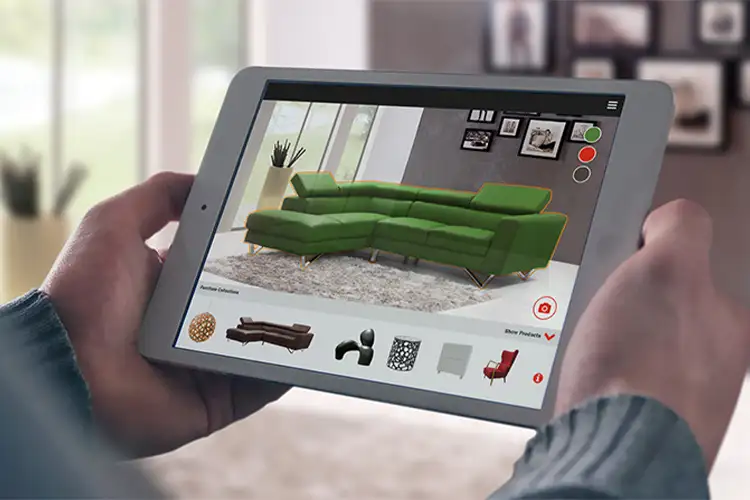
Tom Caudell created the phrase “augmented reality” in 1990 to describe the display that was installed on electricians’ heads to help them through difficult wiring installation.
A virtual or digital object or content is integrated into a real-world environment through augmented reality mobile application software. Augmented reality software is utilised in a variety of industries, including healthcare, education, eCommerce, tourism, entertainment, news media, military, marketing, and more, to suit customer requests or for training reasons.
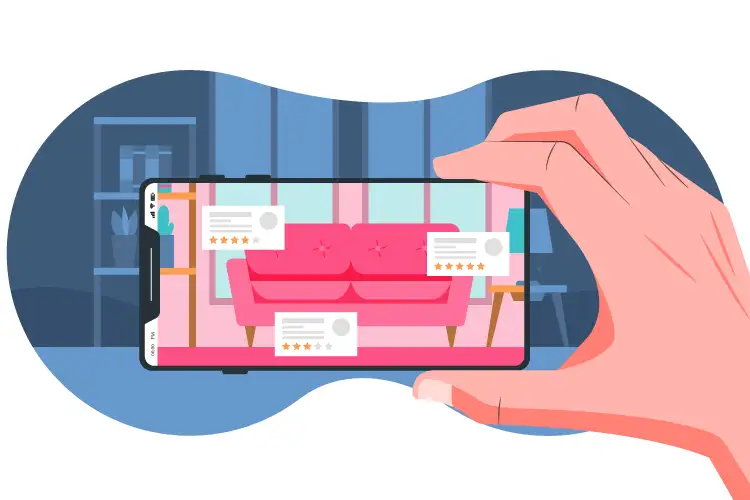
Use Cases and Examples of Augmented Reality Software in Various Industries:
A.) Education:
The increasing rise of eLearning has exposed us to many new and enhanced modern learning techniques, one of which being augmented reality apps. An AR app, rather than providing photos or discussing ideas, allows you to emulate real items to give a new learning experience.
Students may feel connected with the continuing topic and absorb concepts with ease using augmented reality applications, which are one of the most powerful and immersive modes of learning. AR apps may be used to grasp and experience things that would otherwise be impossible to see physically, such as quantum physics, chemistry, biology, astronomy, and others, making it the most inventive form of learning.
Google Sky Map is an augmented reality software for studying astronomy. Students may point their cameras at the sky, and the software will automatically recognise and show stars and constellations, making it an engaging and simple method to study astronomy.
Catchy Words AR is a fun word learning game for youngsters. Kids must use their smartphone to identify and grab letters around them in order to construct words, a novel and engaging approach to learn word formation.
Elements 4D is a chemistry-related augmented reality app. With this AR software, students may perform experiments and learn about the behaviour of various components.
3D Bear App is a creative augmented reality software that is intended to create scenarios with 3D items in order to boost kids’ imagination. Teachers may also use 3D models to construct immersive remote learning lesson plans.
B.) E-commerce:
Augmented reality applications give the eCommerce business yet another method to exhibit their products and services while also improving client happiness.
Although images and videos in online businesses might assist shoppers comprehend the goods, they lack the feel of a physical store where you can touch and try it on. An augmented reality app may duplicate that hands-on experience to put your clients at ease while purchasing your items or services.
63% of online buyers believe that augmented reality features improve their buying experience by bringing the attributes of a physical store to their house.
AR applications like Houzz and IKEA let customers to view and fit the furniture they’ve chosen within their houses. This augmented reality capability is quite useful for designing and complementing the interior layout and décor aesthetics of clients’ houses.
Businesses such as Loreal and Sephora have introduced augmented reality (AR) elements into their respective applications to allow its consumers to experiment with different make-up styles and products. This enhances the user experience by removing the possibility of purchasing inappropriate cosmetic goods.
Want Kicks is a sneakerhead’s fantasy since it allows users to try on different trainers and make educated purchasing selections via augmented reality.
Augment elevates eCommerce to an all new level. It makes it simple to visualise 3D items by combining a camera with augmented reality technologies. You may construct an immersive sales pitch using a 3D model to increase conversion rates.
Walmart used augmented reality gadgets to improve the efficiency of inventory management. Employees may use the gadget to identify ready-to-go boxes rather than scanning each item, decreasing the time it takes for items to reach the shelves.
C.) Medical/Healthcare:
Augmented reality technology may be utilised to create apps for healthcare and medical purposes in a variety of ways. It is an effective tool for modelling severe physical traumas or surgical visualisations in order to design the best therapy for the patient.
AR apps may also be utilised to deliver immersive instruction in a risk-free environment for medical students.
AccuVein is augmented reality software that maps out a patient’s veins on their skin so that injection or IV treatment may be administered precisely and fast. Another example of excellent augmented reality software used to improve healthcare is Augmedics, which provides a see-through map when doing spine procedures.
The Anatomy 4D AR software, which requires just a camera, allows medical students to learn and understand the human anatomy and heart structure in a much more dynamic way.
D.) Tourism:
The necessity for hardcopy maps to travel around a place has been rendered obsolete by the internet and smart phones. Now augmented reality technology takes it a step further by showing accurate routes and tourism recommendations.
Augmented reality smartphone applications may give rich information about places and iconic things in addition to navigation.
Users may use their phone cameras to learn intriguing facts or historical knowledge about places and things.
Using augmented reality applications, visiting new places and nations may be made more easier and more convenient.
AR apps such as AR City and World Around Me may give routes and instructions to help you explore the city and find locations such as restaurants, ATMs, hotels, tourist sites, museums, and more.
ViewRanger is an augmented reality (AR) programme that assists hikers and trekkers over mountains and unfamiliar regions. It can assist users in identifying roads and mountains in their surroundings.
E.) Entertainment:
Mobile augmented reality applications may also be used for entertainment. With phone cameras, this technology may be used to create very immersive arcade games or augmented simulation games.
The most successful example of an augmented reality game is Pokemon GO, which allows users to search and collect pokemon across the city.
Zombie GO is yet another augmented reality game in which players must survive an augmented apocalypse by murdering zombies with their phone cameras.
InkHunter is an augmented reality software that allows you to superimpose various tattoo designs on the user’s skin. Picking a permanent tattoo might be difficult, but this augmented reality tool helps.
Snapchat employs augmented reality to effectively engage and fascinate its users. Users may experiment with a variety of lenses to add unique effects when capturing photos or movies.
F.) Aviation:
The aviation sector can benefit greatly from augmented reality software. With an interactive learning experience, it streamlines pilot training. Pilot trainees can obtain real practise in a safe setting with simulated air traffic control, weather, terrain, and navigation systems.
G.) Marketing:
Numerous businesses and brands have used augmented reality software in innovative and creative ways. This technology provides a platform for interactive advertising campaigns that engage and surprise people.
Pepsi created the “Pepsi MAX: Incredible Bus Shelter” AR campaign, in which they placed HD screens at bus stops with AR 3D animations to delight their audience while they waited for their bus. During 7 days, the video received 24,000 shares and 2 million views, demonstrating the usefulness of augmented reality software in marketing.
Burger King also used augmented reality in a creative way in their smartphone application. Users may use their phone camera and the Burger King app to burn competitor advertising in order to win free burgers.
H.) News media:
Augmented reality software can also aid the journalism and media industries. In addition to using green screens to offer weather predictions, AR may be utilised to produce visualisations of storms, wind, or rain for viewers to simulate vivid and realistic weather conditions.
I.) Army/Military:
The army or defence sector can also benefit from augmented reality software in a variety of ways. The United States Army has been experimenting with Tactical Augmented Reality (TAR) to boost unit effectiveness. The TAR Goggles give a heads-up display that differentiates friendly troops from foes and significantly enhances GPS and night-vision for soldiers.
Now that you’re aware that augmented reality apps may be used in novel ways in nearly every business, let’s talk about augmented reality software development kits.

What is Augmented Reality Software Development Kit (SDK)?
An augmented reality software development kit (SDK) is a collection of tools used to create augmented reality apps by increasing development efficiency and removing faults or problems. It is a boon for makers of augmented reality apps.
AR SDK may be used by app developers to merge digital things into the real environment. With several AR SDK capabilities like as multi-tracking, picture recognition, visual simultaneous localization and mapping (SLAM), 3D object tracking, and more, AR app developers may construct augmented reality apps for different platforms which are from the AR app development company providing the augmented reality app development services.

How to Create Augmented Reality Applications
1.) Market Research
The first and most important step in learning how to construct an AR app is to research the AR app development industry. Investigate augmented reality apps from your rivals and similar sectors on Google Play and Apple App Store.
Understand the typical loading times of various AR applications and study their UI/UX design to eliminate defects and create an exceptional user experience for your target audience.
Examine the reviews, ratings, and feedback of existing AR applications and gather the information to create an ideal AR app development strategy.
2.) Define Requirements
After completing extensive market research, you must establish your needs in order to go forward with your AR app development strategy. This also makes it easier for potential AR app developers to understand what you want from your augmented reality application.
The following methods can be used to determine requirements:
- 1. Particular features for your augmented reality app
- 2. Kind of augmented reality smartphone application: native / hybrid
- 3. Platforms supported include iOS, Android, Windows, macOS, smart goggles, and more.
- 4. Vuforia, ARkit, ARcore, Amazon Sumerian, Wikitude, and more AR app SDKs are available.
- 5. Payment restrictions
- 6. AR apps might be educational, commercial, or entertaining.
3.) Hire AR experts or AR development team
The third step is to employ AR app developers to begin the creation of your AR app. It is essential that you select a competent software development business with the experience to meet all of your needs on time.
Consider the following while selecting an AR development firm:
- – Experience and portfolio;
- – Seamless communication;
- – Transparent development process;
- – Mutual understanding of priorities;
- – App development cost;
- – Customer reviews and feedback;
- – Global benchmarks like ISO certification;
- – NDA agreements;
- – Support and maintenance.
4.) Publish
This is the last step of AR app development. After all of the criteria have been satisfied, problems have been addressed, and app testing has been completed successfully, it is time to publish your AR application. Create your augmented reality app’s title, category, keywords, thumbnail, description, guidelines, and so on, and then launch it. The Apple App Store requires a few days to evaluate the app in accordance with the iOS development requirements, however Google Play Store does not require a review procedure and your AR software is available to download within a few hours.

Conclusion
AR has applications in education, healthcare, eCommerce, marketing, aviation, and other fields. Augmented reality is being welcomed by every industry in order to increase productivity and provide new user experiences.
AR app developers may utilise a variety of SDKs to create flawless augmented reality mobile applications. You may simply construct your own AR app with rigorous market research, clear criteria, and an effective AR app development business.
Contact Us at Digitalfren, where we have a team of experts waiting to serve your needs and goals and produce a product that is well beyond your expectations.